

Quick answer: The mind muscle connection is the deliberate mental focus on a working muscle during exercise, which increases muscle fiber activation and engagement. Building this connection through slower reps, lighter loads, and focused breathing can improve muscle growth, strength training results, and overall workout effectiveness.
Most lifters chase heavier weights and higher rep counts, assuming that progress comes from external numbers alone. But one of the most overlooked variables in muscle growth has nothing to do with how much you lift — it’s how connected you are to the muscle doing the work.
The mind muscle connection is the practice of consciously focusing on a target muscle as it contracts and stretches during an exercise. Research and anecdotal evidence from strength coaches suggest that this mental engagement can meaningfully change how effectively a muscle responds to training. For anyone serious about muscle development, understanding and training this connection is just as important as understanding proper form or progressive overload.
This guide breaks down what the mind muscle connection is, why it matters for muscle growth, and practical ways to build and maintain it across different types of workouts.
What Is the Mind-Muscle Connection and How Does It Work?
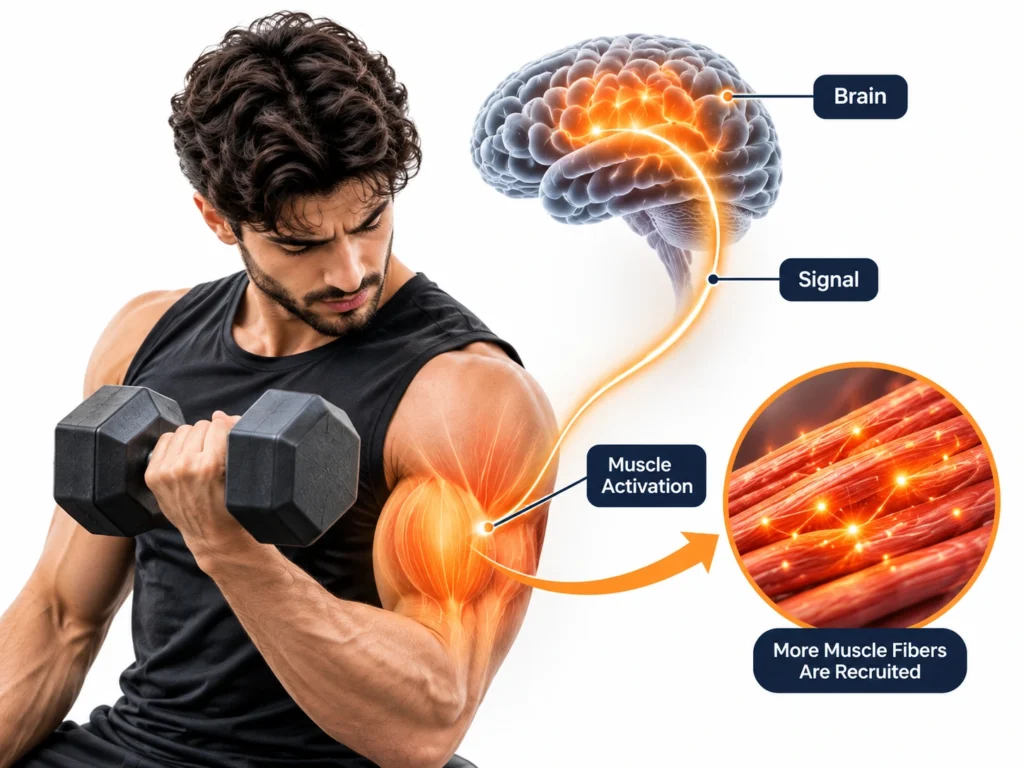
The mind muscle connection refers to the brain-muscle connection formed when a lifter intentionally focuses on the sensation of a specific muscle contracting during an exercise. Instead of simply moving a weight from point A to point B, the lifter directs attention toward the muscle fibers being recruited.
This happens through the neuromuscular system. When the brain sends a signal to a muscle, it activates motor units — groups of muscle fibers controlled by a single nerve. Focused attention appears to increase the recruitment of these motor units, meaning more muscle fibers fire during a given movement. The result is deeper muscle engagement, even when the weight being lifted stays the same.
Think of it as the difference between absentmindedly going through the motions of a bicep curl and consciously feeling the bicep contract at the top of the movement. Both complete the same physical rep, but the muscle activation involved can differ significantly.
Why Is the Mind Muscle Connection Important for Muscle Growth?
Muscle growth, or hypertrophy, depends on effectively recruiting and fatiguing muscle fibers. A strong mind muscle connection helps ensure that the targeted muscle — rather than surrounding muscles or momentum — is doing the bulk of the work.
This matters most in isolation exercises, where the goal is to target one specific muscle group. Without focused muscle control, lifters often let secondary muscles compensate, reducing the effectiveness of the exercise for the intended target. For example, a poorly executed bicep curl might rely heavily on shoulder and back momentum, shortchanging the biceps themselves.
Beyond hypertrophy, the mind muscle connection also supports better workout performance overall. Lifters who train this connection tend to develop a stronger sense of body awareness, which can translate into improved form, reduced injury risk, and more efficient strength training sessions over time.
How to Build a Stronger Mind Muscle Connection
Developing the mind muscle connection takes intentional practice. A few proven strategies include:
- Lower the weight. Reducing resistance allows lifters to focus on proper exercise technique and muscle contraction rather than simply moving the weight.
- Slow down the tempo. Controlled movements, particularly during the eccentric (lowering) phase, give the brain more time to process and reinforce the muscle-brain signal.
- Use visualization. Picturing the target muscle shortening and lengthening during each rep helps direct mental focus to that specific area.
- Incorporate pauses. Briefly holding a muscle at peak contraction — such as pausing at the top of a leg extension — reinforces awareness of that muscle working.
- Practice consistently. Like any skill, the mind muscle connection improves with repetition. Dedicating a few sessions a week to focused, lower-weight training can accelerate progress.
These techniques work best when layered into a training plan gradually, rather than attempting to overhaul an entire workout routine overnight.
Best Exercises to Improve Mind Muscle Connection
Isolation exercises are generally the most effective mind muscle connection exercises because they target a single muscle group without the interference of larger compound movements. Strong options include:
- Bicep curls — ideal for feeling the contraction and stretch of the biceps throughout the full range of motion.
- Leg extensions — useful for isolating and feeling the quadriceps engage without hip or glute involvement.
- Chest flys — effective for chest workouts because they emphasize the stretch and squeeze of the pectoral muscles.
- Lateral raises — helpful for building awareness of the deltoid muscles, which are often underactivated during pressing movements.
- Hamstring curls — a strong choice for isolating the hamstrings, a muscle group commonly neglected in favor of quads.
Resistance training with cables or machines can also make it easier to maintain tension and focus, since the resistance remains constant throughout the movement.
Common Mistakes That Weaken the Mind-Muscle Connection
Several workout mistakes can disrupt or weaken the mind-muscle connection, even in otherwise well-structured training plans:
- Lifting heavy weights too soon. Prioritizing load over form often causes compensation from stronger surrounding muscles, reducing activation in the target area.
- Improper form. Poor exercise technique shifts tension away from the intended muscle and increases injury risk.
- Rushing through reps. Fast, momentum-driven reps leave little room for the brain to engage with the working muscle.
- Training while distracted. Mental distraction — from conversations, phones, or fatigue — makes it difficult to maintain focused awareness during a set.
- Ignoring muscle fatigue cues. Pushing through poor form once a muscle fatigues can shift the work to compensating muscle groups.
Addressing these habits is often the fastest way to improve muscle engagement without changing a workout program entirely.
Does the Mind-Muscle Connection Improve Workout Results?

Yes. A stronger mind-muscle connection generally improves workout effectiveness by increasing muscle activation and supporting muscle hypertrophy. Lifters who train with intentional focus tend to report better muscle fatigue in the target area and more noticeable development over time, even when using similar weights and rep ranges as before.
That said, the mind-muscle connection is one tool among several that contribute to strength training benefits. It works best when combined with progressive overload, adequate recovery, and proper nutrition — not as a replacement for these fundamentals.
Mind-Muscle Connection in Different Fitness Activities
The mind muscle connection isn’t limited to traditional gym fitness settings. It plays a role across a range of physical activities:
- Resistance training. As discussed above, this is where the mind muscle connection is most commonly applied and studied.
- Bodyweight exercises. Movements like push-ups and squats benefit from the same focused engagement, particularly for those without access to weights.
- Yoga. Mindful movement is central to yoga practice, where attention to muscle engagement and breath supports both strength and flexibility.
- Functional training. Activities involving balance and coordination, such as kettlebell work, rely on body awareness that overlaps closely with mind-muscle principles.
Across all these activities, the underlying skill is the same: directing focused attention to the muscles doing the work, rather than simply completing the movement.
Practical Tips to Maintain Mind-Muscle Connection During Workouts
Maintaining the mind-muscle connection throughout an entire workout, not just a single set, requires consistent habits:
- Prioritize breathing techniques. Controlled breathing — exhaling during exertion — helps maintain focus and supports muscle contraction.
- Minimize distractions. Limiting phone use and conversations during working sets helps preserve workout focus.
- Warm up with activation exercises. Light, targeted movements before heavier lifts help “wake up” the muscle being trained.
- Track exercise consistency. Repeating the same focused cues across sessions helps reinforce the muscle-brain connection over time.
- Check in between sets. Briefly assessing which muscles felt most active can help refine technique for subsequent sets.
These small adjustments compound over time, making focused training feel more natural rather than forced.
Frequently Asked Questions About Mind-Muscle Connection
What are the benefits of the mind-muscle connection?
The mind-muscle connection improves muscle activation, supports muscle hypertrophy, and helps ensure the correct muscle group is doing the work during an exercise. It can also improve body awareness and reduce reliance on momentum or compensating muscles.
How long does it take to develop a mind-muscle connection?
Timelines vary by individual, but many lifters notice improved muscle awareness within a few weeks of focused, consistent practice. Full mastery, particularly for less commonly trained muscle groups, can take longer and benefits from ongoing attention.
Does the mind-muscle connection help build muscle?
Yes. By increasing muscle fiber recruitment during exercise, the mind-muscle connection can enhance muscle engagement, which supports hypertrophy when combined with proper training volume and progressive overload.
How do I know if I’m feeling my muscles working?
A muscle that’s properly engaged typically feels warm, fatigued, or “pumped” by the end of a set. If a lifter finishes a set and feels the strain primarily in joints or surrounding muscle groups instead, the mind-muscle connection likely needs more focused attention.
Is the mind-muscle connection only useful for bodybuilders?
No. While bodybuilders often rely on it heavily for muscle isolation, the mind-muscle connection benefits anyone doing resistance training, bodyweight exercises, or mindful movement practices like yoga.
Share Your Fitness Knowledge with The Article Authority
Understanding concepts like the mind-muscle connection is just one part of becoming a more informed, effective lifter. If you have insights, experience, or expertise to share on topics like this, consider submitting a fitness guest post to The Article Authority. It’s a straightforward way to publish your article, reach a wider fitness audience, and contribute to a growing library of practical training knowledge.