Your plant makes thousands of small decisions every hour, and industrial automation software is what makes them fast and repeatable. If you love technology and want to know how factories actually run themselves, this guide covers the tools, the setup steps, and the sizing math most articles skip.
What Is Industrial Automation Software?
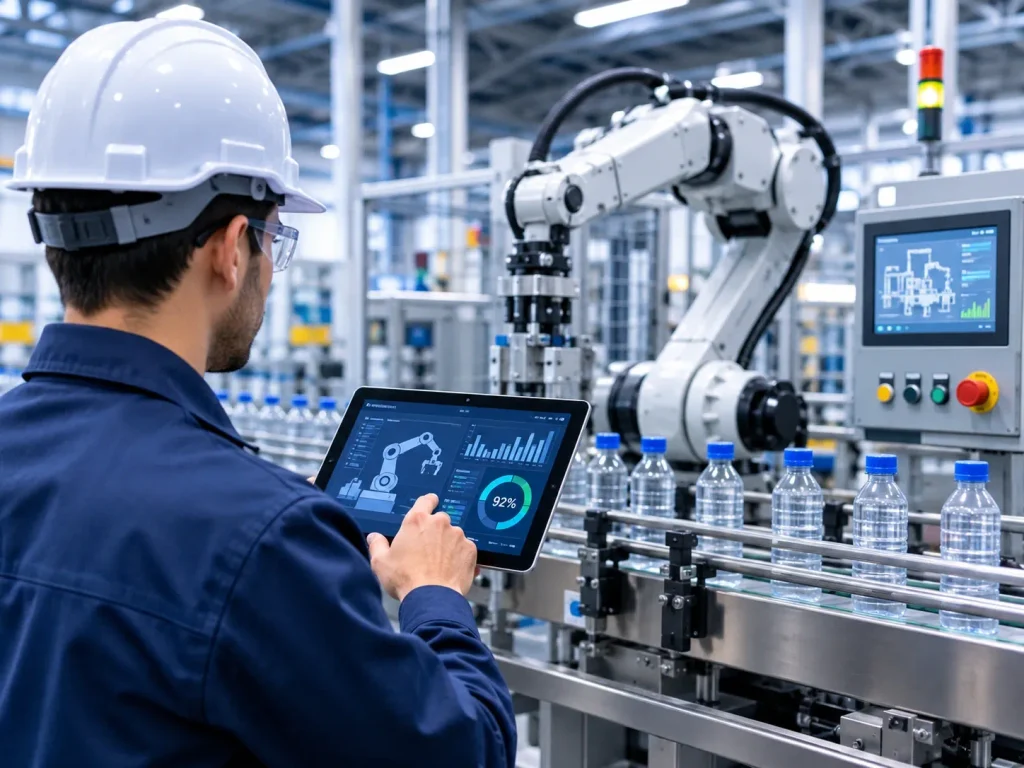
Industrial automation software is the set of programs that monitor, control, and optimize machines on a production floor. It reads sensor data, applies logic, and tells equipment what to do next.
Industrial automation itself means using control systems and software to run industrial processes with minimal manual input. Picture a bottling line that fills, caps, and inspects thousands of bottles an hour while one operator watches a screen. That’s automation doing the repetitive work so people can handle the exceptions.
Why Does It Matter?
Three reasons stand out. Machines behave the same way at 3 a.m. as they do at noon. Every batch leaves a data trail, which makes quality problems easier to trace. And dangerous or tedious tasks move away from people. Speed gets the headlines, but consistency is usually what pays for the project.
What Types of Industrial Automation Software Exist?
Most plants layer several tools, and each one owns a different job.
| Type | What it does | Example use |
| PLC programming software | Writes control logic, often in ladder logic or structured text (IEC 61131-3) | Starting a conveyor when a sensor trips |
| HMI | Gives operators a local screen | A panel beside a packaging machine |
| SCADA | Supervises many machines and archives data | Monitoring pumps across a water network |
| MES | Tracks orders, quality, and traceability | Recording which materials went into which batch |
| OPC UA and middleware | Moves data between vendors’ systems | Sending PLC data to analytics tools |
Automation programs written for a PLC are a different animal from the supervisory software above them. Newcomers often blur the two layers, and that’s where most early confusion starts.
How Do You Implement Factory Automation?
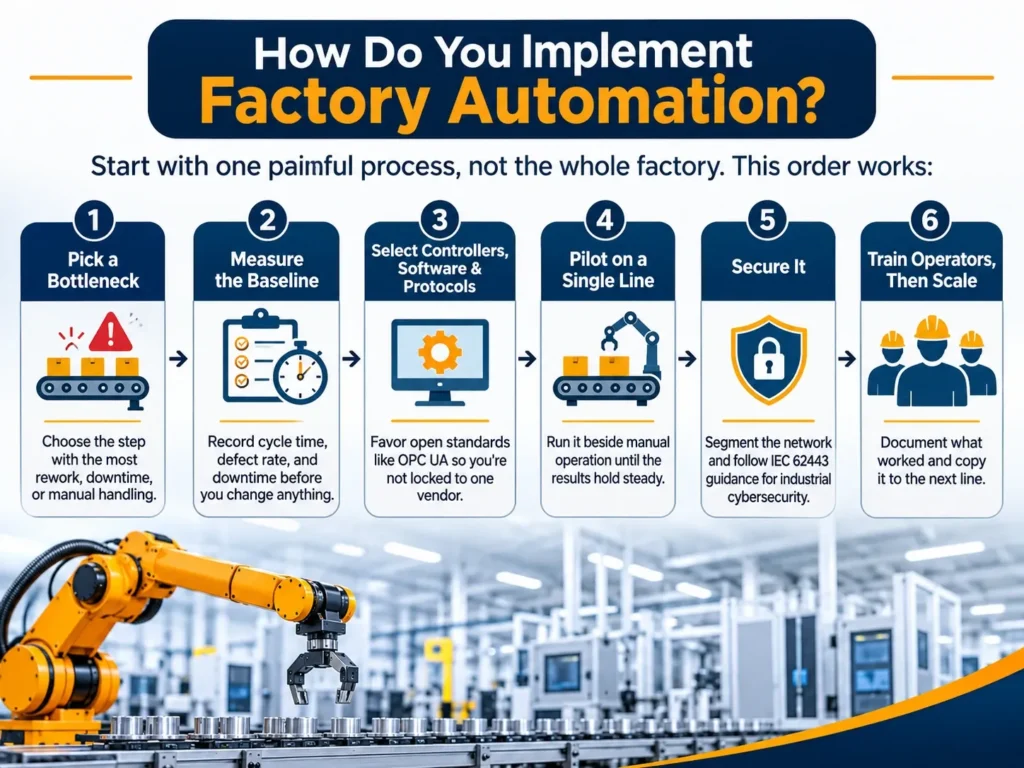
Start with one painful process, not the whole factory. This order works:
- Pick a bottleneck. Choose the step with the most rework, downtime, or manual handling.
- Measure the baseline. Record cycle time, defect rate, and downtime before you change anything.
- Select controllers, software, and protocols. Favor open standards like OPC UA so you’re not locked to one vendor.
- Pilot on a single line. Run it beside manual operation until the results hold steady.
- Secure it. Segment the network and follow IEC 62443 guidance for industrial cybersecurity.
- Train operators, then scale. Document what worked and copy it to the next line.
Skipping step two is the classic mistake. Without a baseline, you can’t prove the project paid off.
A realistic first target is small. Say a packaging line stops six times a shift because a jam sensor misreads. Fixing that one fault with better logic and a clearer HMI alert often saves more than a fancy new system. Win there, show the numbers to your team, and the next budget request gets much easier.
How Do You Choose the Right Industrial Automation Equipment?
Match the equipment to the job first and the budget second. Check the environment before anything else: dust, washdown, heat, and vibration all rule out products. Next, confirm the controller speaks the protocols your existing machines use. Then ask what support and spare parts exist in your region. A cheaper controller that takes weeks to replace costs more than a pricier one sitting on a shelf.
How Do You Size Electric Linear Actuators for Industrial Automation?
Size an electric linear actuator by working through five numbers: load, stroke, speed, voltage, and duty cycle. Each one has to hold at the worst point in the travel, not the average.
- Force: Add the load, friction, and any incline, then include a safety margin.
- Stroke: Measure the full travel you need, plus clearance at both ends.
- Speed: Force and speed trade off. A faster actuator usually pushes less.
- Duty cycle: The ratio of run time to rest time. A 20% rating means two minutes on, eight off.
Here’s a quick example. You need a 12-inch stroke at 1 inch per second, repeated every 30 seconds. Extending and retracting takes 24 seconds of running time. That’s an 80% duty cycle, and a general-purpose actuator rated for 20% will overheat. Choose a continuous-duty unit or slow the cycle.
Always confirm the final pick against the manufacturer’s datasheet, and keep side loads off the rod.
What Mistakes Should You Avoid?
Three show up again and again. Teams buy software before defining the problem, so they end up with dashboards nobody reads. They ignore integration, and a new system that can’t talk to the old PLCs becomes an expensive island. And they treat cybersecurity as a final checkbox, when a factory network that’s open to the internet is an invitation. Fix these three early and most projects run far smoother.
How Is AI Shaping the Future of Industrial Automation?
AI is moving industrial automation from reacting to problems toward predicting them. Predictive maintenance models read vibration, temperature, and current data to flag a failing bearing before it stops a line. Vision systems inspect parts faster than a person can. Major vendors such as Siemens, ABB, and Rockwell are folding these features into their control platforms instead of selling them as add-ons. Edge computing helps too, because a model running next to the machine can react in milliseconds instead of waiting on a cloud round trip.
My view: use AI for advice, not authority. Let models recommend, and let engineers approve anything safety-critical.
Should You Build Custom Industrial Automation Software?
Industrial automation software development makes sense when off-the-shelf tools can’t handle your process, like an unusual machine sequence or a specialized dashboard. Otherwise, configure before you code. Custom code needs testing, documentation, and someone to maintain it after the original developer moves on. Start with vendor tools and write custom programs only for the gaps.
FAQs
What is industrial automation software?
It’s software that monitors and controls industrial machines. It includes PLC programming tools, HMIs, SCADA, and MES, each handling a different layer of production.
What’s the difference between SCADA and MES?
SCADA supervises equipment in real time and archives machine data. MES manages production orders, quality records, and traceability across the plant.
Will AI replace PLC programmers?
No. AI helps with prediction and inspection, but PLCs still run deterministic control logic. Engineers remain responsible for safety-critical decisions.
What’s the most common actuator sizing mistake?
Ignoring duty cycle. People size for force and stroke, then burn out the motor because it runs far more often than its rating allows.
Where Should You Start?
Pick one process, measure it, and automate that first. The software makes sense once you’ve watched it fix a real problem. Writing about tech yourself? Our guest posting site welcomes contributors, and if you’re exploring side income, here’s a home business idea worth a look.