Technological advancements have added years to human life and cut the cost of almost everything we rely on, from medicine to communication. Yet the UN Development Programme’s 2025 Human Development Report found that the projected rise in global human development for 2024 was the smallest since 1990, pandemic years aside. Technology alone doesn’t lift a country. What matters is who can actually use it.
What Are Technological Advancements and Why Do They Matter?
Technological advancements are new tools, methods and systems that let people do more with less time, money or effort. Human development, as UNDP measures it through the Human Development Index, tracks three things: health, education and standard of living. Technology touches all three.
Technology improvement rarely arrives as one dramatic invention. It’s usually a slow decline in cost. A machine that once filled a room and cost a fortune ends up in a pocket. Repeat that pattern across medicine, energy and computing, and a lab result becomes a rise in everyday living standards.
What Is the Relationship Between Technology and Standard of Living?
Technology raises the standard of living by making essentials cheaper and more available, and by increasing how much one worker can produce in an hour. Higher productivity is what pays for higher wages, better schools and stronger health systems. Here is how that plays out in four areas:
| Area | How technology helps | Example |
| Health | Earlier diagnosis and wider vaccine coverage | Telemedicine, mRNA vaccines |
| Education | Learning beyond the classroom wall | Online courses, digital libraries |
| Income | More output per worker per hour | Automated production lines |
| Daily life | Cheaper communication and payments | Mobile banking, video calls |
The catch is access. The International Telecommunication Union (ITU) estimates that 74% of the world, about 6 billion people, used the internet in 2025. That sounds like a win until you split it by income: 94% in high-income countries, just 23% in low-income ones. Roughly 2.2 billion people remain offline.
How Has the Rise of Technology Changed Economics?
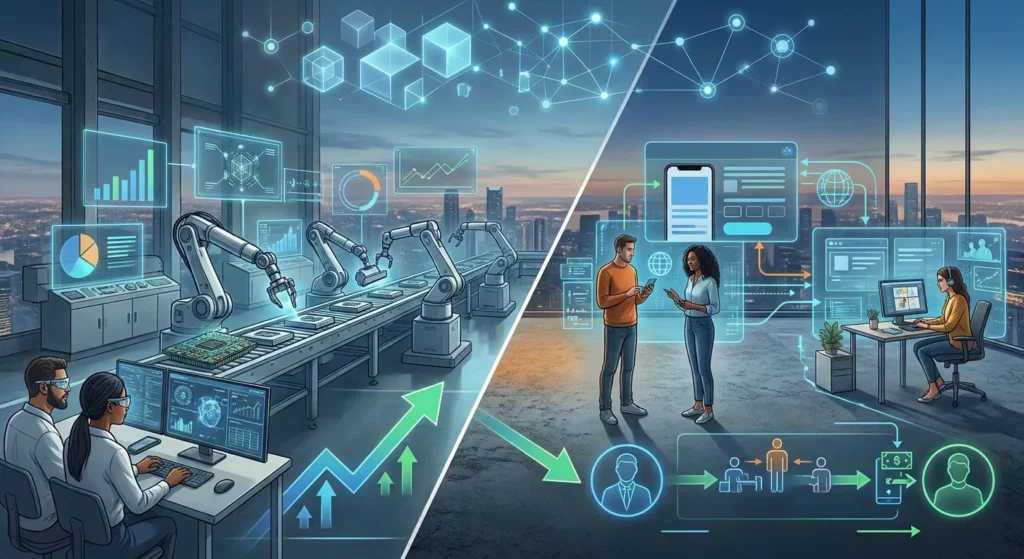
The rise of technology reshapes economics through three channels: productivity, new markets and lower transaction costs. Productivity means more output per worker. New markets mean industries, such as app development or online freelancing, that didn’t exist a generation ago. Lower transaction costs mean a buyer and a seller can find each other, agree on a price and settle payment without a middleman taking a large cut.
Factories show the productivity channel most clearly. Industrial Automation Software lets a plant run machines, track output and flag faults with fewer people on the floor. Output per worker climbs. But the same software can remove routine roles, which is why technology in economics always comes with a retraining bill that someone has to pay.
In our view, the economies that benefit most aren’t the ones that automate fastest. They’re the ones that move displaced workers into better work quickly.
What Are Examples of Technology in Globalization?
Technology drives globalization by cutting the cost of moving information, money and goods across borders. Five examples show how:
- Container shipping and digital logistics tracking, which let manufacturers coordinate supply chains across continents.
- Undersea internet cables and cloud platforms, which let a company in one country serve customers in another in real time.
- Digital payments, which let people send money across borders without visiting a bank branch.
- Remote work and freelance platforms, which let employers hire talent anywhere.
- Online publishing. A Guest posting Website such as The Article Authority lets a writer in one country reach readers in another, with no printer or distributor involved.
Who Gets Left Behind by Technological Progress?
The ITU’s 2025 data shows the divide runs along several lines at once. About 85% of people in urban areas are online, versus 58% in rural areas. Men are online at 77%, women at 71%. And 96% of the people still offline live in low- and middle-income countries.
AI is the newest test. A UNDP survey across 21 countries found that about 20% of respondents had recently used AI for work, health or education, while roughly two-thirds expected to within a year. UNDP also warns that the benefits could flow mostly to wealthier nations unless access, education and infrastructure improve.
The fix isn’t mysterious. Cables matter, but so do affordable data plans and digital skills, the two barriers the ITU names as essential to meaningful connectivity. Governments that fund skills alongside infrastructure will get far more from every new technology than those that only build networks.
How Can Professionals Put Technology to Work for Development?
Professionals can support human development by choosing technology that solves a measurable problem, then training the people who will use it. That sounds obvious, yet many projects stall because the tool arrives before the skills do. Four habits separate the projects that work from the ones that don’t:
- Start with the bottleneck. Find the single step slowing down a clinic, school or factory, and test technology there first.
- Budget for training. A tool nobody understands saves no time, and the ITU names digital skills as one of the two biggest barriers to meaningful connectivity.
- Measure outcomes, not installations. Count patients seen, students graduated or hours saved, not devices deployed.
- Plan for the workers affected. If automation removes a role, offer a route into a new one before the change, not after.
None of this needs a large budget. A small team that fixes one bottleneck well will do more for living standards than a big rollout nobody asked for. The same logic applies to writers and publishers: a clear, accurate explainer on a new technology helps decision-makers choose better tools.
Frequently Asked Questions
How do technological advancements affect human development?
They raise income, health and education by making essentials cheaper and workers more productive. UNDP’s Human Development Index measures those three areas. The effect is uneven, though, because the benefits depend on who has access to the technology.
What is the difference between technology and a technological advancement?
Technology is any tool or method used to solve a problem. A technological advancement is a meaningful improvement on it, such as a faster, cheaper or more accurate version. A hammer is technology; a power drill is an advancement.
Does technology always improve the standard of living?
No. It improves living standards when people can afford it and have the skills to use it. Only 23% of people in low-income countries use the internet, according to the ITU’s 2025 data, so many are still shut out of the gains.
How does technology influence the global economy?
It raises productivity, opens new markets and lowers the cost of trade and payments. It also shifts jobs between sectors, so the net effect depends on how well displaced workers are retrained.
Which technologies matter most for human development today?
Mobile internet, digital payments, clean energy, health technology and AI. Connectivity comes first, because the rest depend on being online.
What Should You Take From This?
Technological advancements expand what people can do, but they don’t distribute themselves fairly. When you assess any new technology, track three things: who can afford it, who has the skills to use it, and who loses work because of it. The rise of technology is a tool, and tools reflect the choices of the people holding them. Want more technology analysis? Read more at The Article Authority.