

Customer service is the help a business gives people before, during and after they buy from it. If you run a small business, plan to start one, or study business, that definition is only the starting point. What matters is how the help works in practice, why it affects revenue, and what you can learn from it. This guide explains all three.
What Is Customer Service?
Customer service is the assistance a company provides to customers at every stage of their relationship with it. It includes answering questions, solving problems, handling complaints and making the buying process easier. Good service is not limited to a support desk. A shop assistant who finds the right size is doing it, and so is an online seller who replies to a delivery query within the hour.
Customer Servicing Meaning
You will also see the phrase customer servicing. The customer servicing meaning is close to the standard definition, but it points to the ongoing work behind the scenes: processing requests, managing accounts, tracking orders and following up on open issues. Put simply, service is the quality of the help a customer receives. Servicing is the routine that delivers it.
What Is Individual Consumer Customer Service?
Individual consumer customer service is the support a business gives to a single person who buys for personal use rather than for a company. Think of a student returning a laptop charger or a shopper asking about a refund. These customers decide quickly, often compare you with a competitor in another browser tab, and judge you on how one interaction felt.
The table below shows how this differs from serving other businesses.
| Factor | Individual consumer | Business client |
| Buyer | One person, personal use | A team or company |
| Decision speed | Fast, often the same day | Slower, may need approval |
| Common issues | Refunds, delivery, product use | Contracts, invoices, bulk orders |
| What they value | Speed and a friendly tone | Reliability and account support |
| Typical channels | Chat, social media, email | Email, calls, account managers |
What Are the Main Types of Customer Service?
Support falls into four broad types, depending on when the customer needs it.
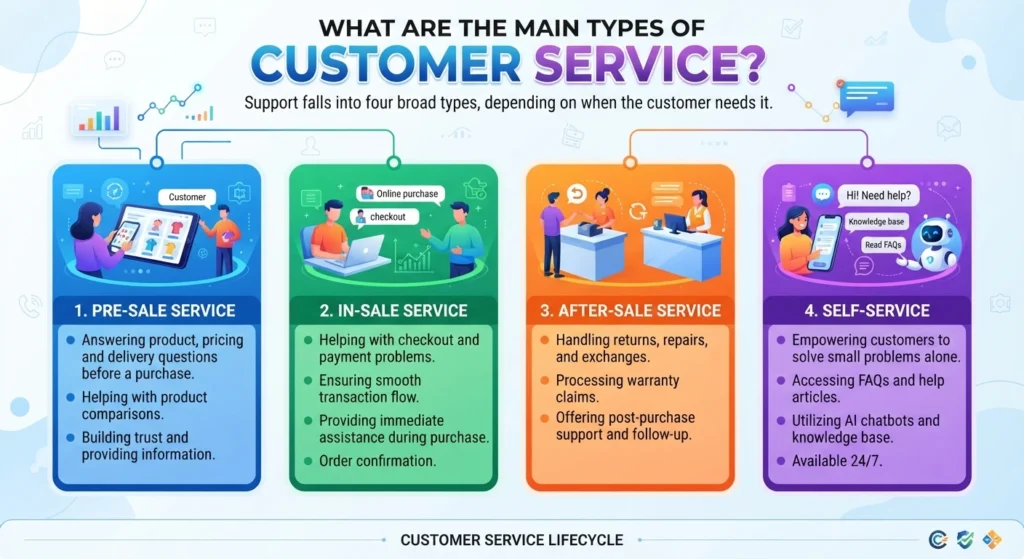
- Pre-sale service: answering product, pricing and delivery questions before a purchase.
- In-sale service: helping with checkout, payment problems and order confirmation.
- After-sale service: handling returns, repairs, warranty claims and follow-up.
- Self-service: FAQs, help articles and chatbots that let customers solve small problems alone.
Most businesses deliver these through phone, email, live chat, social media and in-person contact. A small business rarely needs every channel. Pick two you can answer quickly and do those well.
What Is Customer Service and Why Is It Important?
Customer service is important because it decides whether a buyer comes back. Strong support keeps existing customers, earns referrals and protects your reputation. For a small business, it often becomes the main advantage over larger rivals.
Retention comes first. Winning a new customer generally costs more than keeping one you already have, so every resolved complaint saves marketing money. Referrals follow. People rarely recommend a business for being merely adequate, but they will mention one that fixed a problem without argument.
Reputation matters too, especially online. A single unanswered complaint can become a public review that future buyers read before they contact you. And if you cannot match a bigger company on price, you can still beat it on attention. A founder who answers personally offers something a large brand struggles to copy.
There is also a plain cost argument. Support teams hear problems first, so a business that listens early avoids bigger failures later: a faulty batch, a confusing checkout, a misleading product description. Treat every complaint as a cheap warning, not a nuisance, and you will catch issues before they reach hundreds of buyers.
For students, the topic carries extra weight. Customer service sits inside marketing, operations and management courses, and employers test for it directly in interviews.
How Can Customer Service Information Be Used?
Customer service information is everything your support work records: complaints, chat logs, emails, return reasons, survey scores and response times. Used well, it works as free market research. Here is how to put it to work.
- Fix repeating problems. If a large share of your messages ask the same question, the cause sits in your product, page or process, not in the customers.
- Improve your content. Turn common questions into FAQs, product page details and blog posts.
- Train your team. Real conversations show which answers work and where staff hesitate.
- Personalize offers. Purchase and support history shows what a customer is likely to need next.
- Plan staffing. Ticket volume by day and hour tells you when people need to be available.
- Measure performance. Track first response time, resolution time and satisfaction scores month to month.
Consider a hypothetical online store that notices 30 of its last 100 messages ask when an order will arrive. Adding a delivery estimate to every product page removes most of those messages in a single edit.
One caution applies. Customer data is personal. Collect only what you need, store it securely, and follow the privacy rules in the countries where your customers live.
What Does Good Customer Service Look Like?
- Reply quickly, and say when a full answer will arrive if you cannot give one now.
- Be specific. Tell the customer what you will do and by when.
- Own mistakes without excuses, then fix them.
- Give staff the authority to solve small problems without asking a manager.
- Follow up after resolving an issue to confirm the customer is satisfied.
The skills behind this are plain ones: clear writing, listening, patience and problem solving. Product knowledge is the one beginners underrate. A friendly agent who cannot answer the question still leaves the customer stuck.
Where to Start
Begin with one task this week. List the five questions customers ask most and answer each in writing on your site. That single step improves service and gives you your first usable data. For more guides like this, read our other business related blogs on The Article Authority.
Frequently Asked Questions
What is customer service in simple words?
Customer service is the help a business gives its customers before, during and after a purchase. It covers answering questions, fixing problems and making buying easier.
What is the meaning of customer servicing?
Customer servicing refers to the ongoing work of handling customer needs, such as processing requests, managing accounts, tracking orders and following up on issues. It is the routine behind customer service.
What is individual consumer customer service?
It is the support a business provides to one person buying for personal use, such as help with a refund, a delivery or a product question. It differs from business client service because decisions are faster and more personal.
Why is customer service important for small businesses?
Small businesses often compete on attention rather than price. Good service builds loyalty, produces referrals and protects online reviews, all of which lower the cost of finding new customers.
How can customer service information be used?
Businesses use complaints, chat logs, return reasons and survey scores to fix repeating problems, train staff, write better FAQs, plan staffing and track service quality over time.